Print

Epitope mapping service

Determination of interacting linear epitope


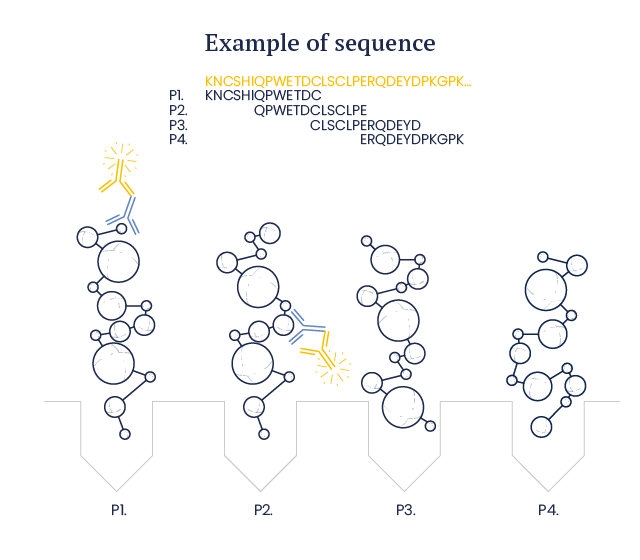
We also offer epitope mapping as an in-house service. Just send us your monoclonal antibody raised against a protein and we shall synthesise the overlapping peptide library and determine which sequence corresponds to the antibody's recognition site.


Name Length (AA) Quantity Reference EUR
Determination of epitope from your Mab Per antibody
Basic peptide library 5 < 1 mg AS-HTPP-CR05 45.00
Basic peptide library 6 < 1 mg AS-HTPP-CR06 45.00
Basic peptide library 7 < 1 mg AS-HTPP-CR07 45.00
Basic peptide library 8 < 1 mg AS-HTPP-CR08 45.00
Basic peptide library 9 < 1 mg AS-HTPP-CR09 45.00
Basic peptide library 10 < 1 mg AS-HTPP-CR10 45.00
Basic peptide library 11 < 1 mg AS-HTPP-CR11 45.00
Basic peptide library 12 < 1 mg AS-HTPP-CR12 45.00
Basic peptide library 13 < 1 mg AS-HTPP-CR13 45.00
Basic peptide library 14 < 1 mg AS-HTPP-CR14 45.00
Basic peptide library 15 < 1 mg AS-HTPP-CR15 45.00
Basic peptide library 16 < 1 mg AS-HTPP-CR16 45.00
Basic peptide library 17 < 1 mg AS-HTPP-CR17 45.00
Basic peptide library 18 < 1 mg AS-HTPP-CR18 45.00


Legal notices

   For research use only

FAQ

  • QWhat type of chemistry do you use?
    AEurogentec uses solid phase Fmoc chemistry rather than tBOC chemistry. Peptides synthesised by tBOC chemistry require more purification due to the harsh synthesis conditions and specific equipment related to the use of hydrofluoric acid (HF).
  • QWhat quality control (QC) information do you provide?
    AAll peptides are analysed by MS to confirm the molecular weight. For peptides where a minimum purity has been requested we also run reverse-phase HPLC analyses. The results from these analyses are included on the Technical Datasheet (TDS) supplied with the peptides delivered.
  • QHow are the peptides supplied?
    APeptides are shipped lyophilised at room temperature via express courier.
  • QHow should my peptide be stored?
    A

    Lyophilized peptides should be stored away from heat, light and moisture. Under these conditions lyophilised peptides are stable at room temperature for days to weeks, for longer term storage, peptides should be stored under the same conditions but at -20 °C.

    As moisture will greatly reduce the long term stability of peptides, peptides should be allowed to equilibrate to room temperature in a desiccator before dispensing, thus avoiding exposure to moisture in the air which will condense on the peptide. Once dispensed, the tube should be gently purged with anhydrous nitrogen or argon, the container recapped, sealed with parafilm and stored at -20 °C.

    In solution, some slow degradation reactions could take place, the rate of which will be sequence dependent. Possible degradation reactions in solution include:

    • Oxidation of Cys, Met and Trp
    • Deamidation of Gln and Asn to Glu and Asp respectively
    • Oxidative cyclisation to form Cys-Cys
  • QHow do I know if my peptide will be soluble?
    AThe solubility of a peptide is often hard to predict and in the more difficult cases requires multiple attempts to find the best combination of solvents and pH. Please see "How should I solubilise my peptide".
  • QHow should I solubilize my peptide?
    A

    Peptide solubility characteristics vary strongly from one peptide to another and are very difficult to predict. Residues such as Ala, Cys, Ile, Leu, Met, Phe, and Val will increase the chance of the peptide having solubility problems.
    The best solvent to use will depend on the solubility properties of the peptide and solvent requirements of your assay. We recommend predicting the physical properties of the peptide, dissolving the peptide as a function of these physical properties and then adapting the solubility results experimentally.

    1. From the technical datasheet note the "Charge at pH 7" parameter
    2. Calculate the percentage of hydrophobic residues

    A. If the "Charge at pH 7" is negative and percent hydrophobic residues is < 50 %
    1. Dissolve the peptide in a minimum amount of sterile distilled water and sonicate if necessary, if it goes in solution dilute to the desired peptide concentration with assay solution
    2. If not add in a dropwise fashion (50 uL) of 0.1N acetic acid in sterile distilled water to the desired peptide concentration for your assay and sonicate if necessary. Acetic acid is volatile and will be removed during lyophilization should the peptide not go into solution.
    3. If the peptide still does not go into solution then lyophilise and go to procedure C

    B. If the "Charge at pH 7" is positive and percent hydrophobic residues is < 50 %
    1. Dissolve the peptide in a minimum amount of sterile distilled water and sonicate if necessary, if it goes in solution dilute to the desired peptide concentration with assay solution.
    2. If not add in a dropwise fashion (50 uL) of 0.1N ammonium bicarbonate in sterile distilled water to the desired peptide concentration for your assay and sonicate if necessary. Ammonium bicarbonate is volatile and will be removed during lyophilization should the peptide not go into solution.
    3. If the peptide still does not go into solution then lyophilise and go to procedure C

    C. If the percent hydrophobic residues > 50 %
    1. Dissolve the peptide in a minimum amount of acetonitrile or isopropanol. These solvents are useful for solubilising organic compounds, and can still be removed by lyophilization. If the material does not go into solution then sonicate. Once in solution dilute to the desired peptide concentration with assay solution.
    2. If not dissolve the peptide in a minimum amount of DMSO or DMF. These solvents are useful for solubilising organic compounds, but due to their very high boiling points are difficult to remove by lyophilization. If the material does not go into solution then sonicate. If the peptide goes into solution dilute to the desired peptide concentration with assay solution.
    3. If not then the use of chaotropic salts such as guanidine hydrochloride or urea is recommended. These will dissolve most peptides, the choice of which will depend on the compatibility with your assay system.

  • QWhat type of spacer is there between a biotin and the peptide on a biotinylated peptide?
    AThe standard biotin modification does not include a spacer. Spacers are available on request.
  • QHow do you confirm a peptide is cyclised?
    A

    There are two types of cyclisations that can be performed:
    1. N-terminal to C-terminal cyclisation
    2. Disulfide bridge cyclisation
    N-terminal to C-termal cyclisation is confirmed by a molecular weight shift of 18 mass units in the Maldi-Tof mass spectrum. A disulfide bridge cyclisation is confirmed by MS and HPLC before and after the cyclisation step. Although a mass shift of 2 mass units can be difficult to detect for certain peptides, an HPLC shift helps confirm the completion of the reaction.

  • QDo you synthesize 'wobble' peptides?
    AYes, we can synthesize wobble peptides. As there are known differences in the incorporation rates of different amino acids, we can compensate for these rates to produce roughly equimolar amounts of each wobble peptide.
  • QDo you synthesize isotopically labelled peptides?
    AWe can synthesise peptides containing non-radioactive atoms from commercially available building blocks. This includes amino acids containing 13C, 15N for NMR work for example.
  • QWhat is gross peptide weight?
    AThe gross peptide weight is the weight determined after weighing the peptide. This is the amount indicated on the tube.
  • QWhat does net peptide content mean?
    AThe gross weight of dry peptide doesn't consist of peptide only, but includes non-peptide components such as water, absorbed solvents, counter ions and salts. Net peptide content is the actual percent weight of peptide from the gross weight. This number may vary, from 50-90 percent, depending on the purity, sequence and method of synthesis and purification.
  • QWhat is the difference between peptide content and peptide purity?
    APeptide content is not an indication of peptide purity; these are two measurements. Purity is determined by HPLC and indicates the presence/absence of contaminating peptides with undesired sequences. Net peptide content only gives information on the percent of total peptide versus total non-peptide components independently of the presence of multiple peptides. Net peptide content is accurately found by performing amino acid analysis or UV spectrophotometry. This information is important when calculating concentrations of peptide during sensitive experiments.
  • QHow do you generally purify your peptides?
    AOur peptides are generally purified by preparative reversed phase HPLC, using two tri-fluoro acetic acid (TFA) modified buffers at pH 2. Buffer A is 0.1 % TFA in deionised water and buffer B is 0.1 % TFA in acetonitrile (ACN) at pH 2. Peptides are dissolved in either straight buffer A, or some amount of buffer B then diluted with buffer A. Sometimes it is necessary to use an organic polar solvent like (formic acid or acetic acid) in DMSO or DMF to aid in the dissolving of hydrophobic peptides but this is done on a case-by-case basis depending on the sequence anaylsis. On rare occasions we can get better solubility and therefore better purification at pH 6.8 so in that case we dissolve the peptide and run the gradient using two alternate buffers. The pH 6.8 buffers we use are 10 mM ammonium acetate in deionised water (buffer A) or ACN (buffer B). The separation is monitored by UV at 214 nm and fractions are collected and analysed by MADLI-TOF mass spectrometry for product identity and by reversed phase analytical HPLC for purity. The fractions are then lyophilised to remove the solvents. The fractions that meet the specifications of the order are then combined into one vial. Next, we run a final MALDI-TOF and analytical HPLC on the combined material.
  • QWhat is MALDI-TOF?
    AMALDI stands for Matrix Assisted Laser Desorption - Time of Flight. This machine is used to determine the mass of molecules present in a sample. We can confirm that we have the correct peptide by comparing the theoretical molecular mass of the peptide synthesized with the experimentally determine molecular mass of the synthetic material.
  • QCan you explain the M+Na and M+K mass peaks in MALDI spectra?
    AIt is very common to see Na (sodium) and K (potassium) adducts in the MALDI spectrum. The sodium and potassium comes from the water used in the peptide solvents. Even distilled and deionized water has trace amounts of sodium and potassium ions, which can never be entirely removed. These become ionized during the MALDI mass spec process and bind to the free carboxyl groups of the peptide. Because there is no water purification system that will remove every single sodium or potassium ion from water, seeing the sodium and potassium adducts at times is very common and unavoidable in MALDI mass spec. This is not an indication that the peptide is not pure, nor should it be confused with an incorrect molecular weight.
  • QHow long should a peptide that is going to be used as an antigen for antibody production be?
    AWe usually use peptides that are 13 to 15 amino acids long in length, however shorter and longer peptides have been known to work. We have successfully raised anti-peptide antibodies to peptides that differ in the presence/absence of a single phosphate (our phospho-specific antibody programme). Antibodies typically recognise epitopes are typically between 6-8 amino acids, by presenting a peptide that is 15 amino acids long we increase the likelihood of generating useful antibodies but limit the chance of producing a peptide with a secondary structure that might be unrelated to the antigen.
  • QWhat should I do with the ends of my peptides, keep them free or block them?
    AIn order to mimic a protein's physical and chemical properties, you should request peptides that have a similar structure and charge to the protein. For peptide sequences that represent the N-terminus we recommend keeping the N-terminus as NH2 like in the protein, and modifying the C-terminus with an amide group to mimic a peptide linkage. For peptide sequences that represent the C-terminus we recommend keeping the C-terminus as COOH like in the protein and modifying the N-terminus with an acetyl group to mimic a peptide linkage. For internal peptides both ends of the peptide should be modified (N-terminal acetyl and C-terminal amide) to mimic both peptide linkages.
  • QWhat methods do you recommend to conjugate a peptide to a carrier molecule?
    AThe most important factor is that the site of conjugation be not an internal amino acid and that the site of conjugation be specific for a single amino acid. Internal amino acids and multiple conjugation sites will not present the peptide in a way that is most similar to the natural antigen. After that the choice of chemistry will be dependent on the type of amino acids present in the sequence.


    Chemistry
    Site of reaction
    Not in the presence of
    Comments
    Glutaraldehyde
    N-terminal NH2 group
    Lys (K) or an acetylated N-terminus or a Pro(P) N-terminus
    Not useful for peptides that correspond to the N-terminus of the antigen
    EDCI
    C-terminal COOH group
    Glu (E), Asp (D) or an amidated C-terminus
    Not useful for peptides that correspond to the C-terminus of the antigen
    MAP-8
    C-terminal COOH group
    -
    Lower antigenicity than coupling to a carrier protein
    BDB
    Terminal tyrosine
    Another Tyr (Y), Lys (K), Cys (C), His (H)
    Limited utility
    MBS
    Side chain thiol of cysteine
    Another Cysteine (C)
    Commonly used approach, usually via the addition of an extra Cys (C) to the sequence at either the N- or C-terminus

Product citations


BECAMEL C. et al., "The Serotonin 5-HT2A and 5-HT2C Receptors Interact with Specific Sets of PDZ Proteins", Journal of Biological Chemistry, vol. 279, n° 19, p. 20257-20266, May 2004


BOUDSOCQ M. et al., "Identification of Nine Sucrose Nonfermenting 1-related Protein Kinases 2 Activated by Hyperosmotic and Saline Stresses in Arabidopsis thaliana", Journal of Biological Chemistry, vol. 279, n° 40, p. 41758-41766, October 2004


MORGAN C. et al., "Phosphorylation of a Distinct Structural Form of Phosphatidylinositol Transfer Protein a at Ser166 by Protein Kinase C Disrupts Receptor-mediated Phospholipase C Signaling by Inhibiting Delivery of Phosphatidylinositol to Membranes", Journal of Biological Chemistry, vol. 279, n° 45, p. 47159-47171, November 2004


BIKKER F. et al., "Bacteria Binding by DMBT1/SAG/gp-340 Is Confined to the VEVLXXXXW Motif in Its Scavenger Receptor Cysteine-rich Domains", Journal of Biological Chemistry, vol. 279, n° 46, p. 47699-47703, November 2004


SIX E. et al., "The Notch Ligand Delta1 Recruits Dlg1 at Cell-Cell Contacts and Regulates Cell Migration", Journal of Biological Chemistry, vol. 279, n° 53, p. 55818-55826, December 2004


MIGEOTTE et al., "Identification and characterization of an endogenous chemotactic ligand specific for FPRL2", JEM, vol. 201, n° 1, 1-12, January 2005


Please provide all of the following information so that we may begin to process your order


    • Peptide sequence, quantity, purity and the following
• Purchase order number from your institute
• Product references and prices
• Other important production information

 
  Delivery information
• Name
• Shipping Address
• Telephone
• Email
Invoicing information
• Name
• Shipping Address
• Telephone
• Email


  • Online
    You can place your order online. Login to access our web ordering interface.
  • By fax : +32 4 264 07 88
  • By mail
    Eurogentec S.A.
    LIEGE Science Park
    Rue du Bois Saint Jean 5
    4102 Seraing
    BELGIUM

If you still have questions with ordering please contact our Customer Support : +32 4 372 76 65.


To receive relevant information on our products, you should first select your country :
Country selection page