Solutions for the industry
Large scale antibody production
We have the expertise and capacity to produce both custom monoclonal and polyclonal antibodies in large volume. We are able to handle large demanding projects with remarkable flexibility to meet the customer’s requirements and SOP's.
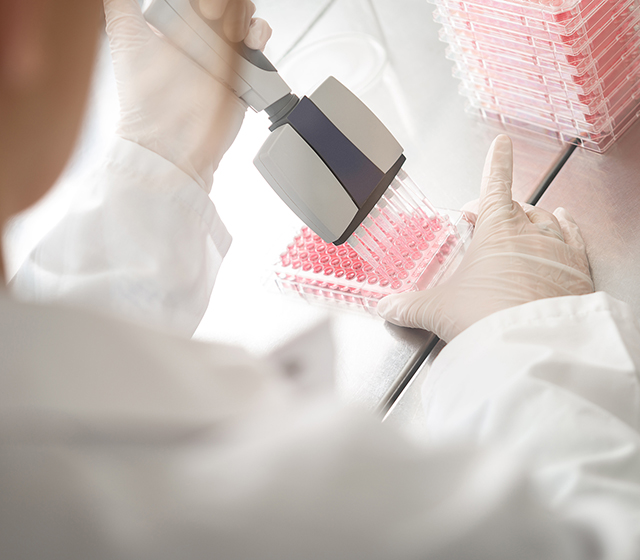
25 years+ Expertise in antibody development and production
For over 25 years, Eurogentec has been recognized as a trusted manufacturer of custom antibodies dedicated to diagnostic, biotech and pharma partners worldwide.
We develop antibodies with high flexibility and a strong focus on customer service. A team of project managers directly handles the requests and adapts our processes and strategies to best meet our sponsors’ needs. Some processes may be subject to an evaluation by the ethical committee for approval.
Trusted quality
Delivering high-quality products is fundamental for us.
Our comprehensive Quality Management System ensures that our customers receive the product they need.
Belgian facilities
Located in Belgium, our State-of-the-art facilities enable us to produce from small to very large batches of monoclonal or polyclonal antibodies.
Our facilities are equipped with advanced technologies for antibody production, operated by experienced scientists.
Animal welfare
The facilities comply with the highest standards for animal welfare, including FELASA, GLP, GMP, BELAC, UK Home Office Animals Scientific Procedures Act.
GMP
Antibodies fragments can be produced in our GMP biomanufacturing facilities, accredited by Belgian Health Authorities. They are equipped with 4 GMP Fermentation suites (from 80 L to 2200 L fermenters).
Polyclonal antibody production
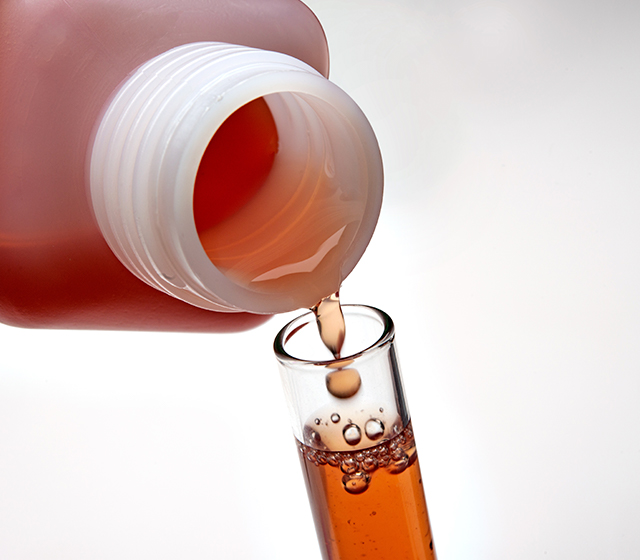
We adapt the production to the customer’s project size. We produce and deliver serum from small to large volume, or up to multiple grams of purified antibodies .
According to the project, we can handle regularly several liters of serum from rabbits or goats.
Our immunization programs can also be conducted over a long period of time.
Large scale monoclonal antibody production
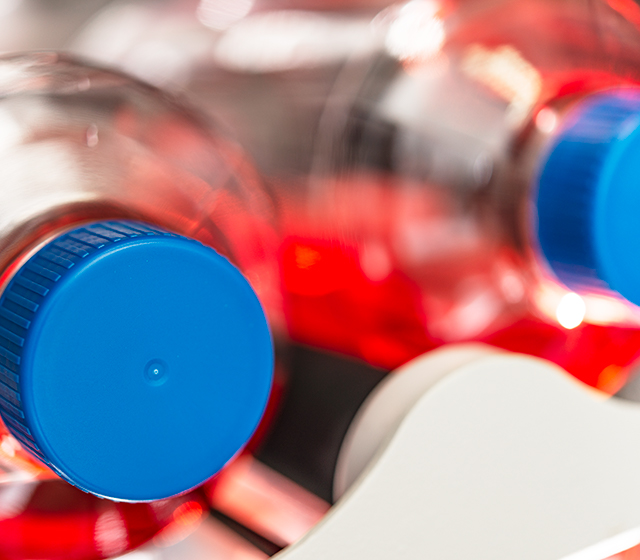
Producing monoclonal antibodies in vitro from hybridoma is an efficient and reproducible process. Depending on the request, we can generate up to 100 g high quality mAbs using adapted production scheme, or our proprietary technology to boost the cells production yields.
We can manage projects from the generation of hybridomas and molecular engineering of mAbs up to dedicated QC and characterization, purification, and formatting.
FAQs
Which animal should I use for antibody production?
The choice of animal is dependent on practical factors such as the source of the antigen, quantity of serum required for research, the titer of the antibody and the time required to generate antibodies. Antigens coming from rabbits should be injected into pigs or chickens rather than into rabbits. Mammalian proteins can be injected into chickens to provide high titer antibodies, which have the advantage of being IgY type antibodies.
Program duration: generally, the smaller the animal the shorter the program duration and the smaller the volumes of serum received. As antigenic response varies from animal to animal of the same species, repeating a immunization program is more risky than choosing a larger animal for antibody production to ensure sufficient material. It is recommended to immunize at least 2 animals to ensure a high quality antibody at the end of the program.
What are the expected bleed volumes?
The immune response depends on the antigen but also on the host. Large animals provide the advantage of allowing larger bleeds but their immune response is generally lower than small animals. The following table indicates the expected bleed volume in various hosts.
| Pre-immune | Small Bleed | Large bleed |
Final bleed | Comment | |
| Mouse | 40-70 μL | 40-70 μL | 40-70 μL | 300-500 μL | Good to test antigenicity |
| Guinea pig |
1 mL | 1 mL | 2-3 mL | 10-15 mL | For small serum volumes |
| Rat | 2 mL | 2 mL | 2 mL | 5 mL | For small serum volumes |
| Chicken | 1 egg | ± 8-10 eggs* | ± 8-10 eggs* | ± 8-10 eggs* | For mammalian antigens and large quantities of Antibodies, 4 eggs = |
| Rabbit | 2 mL | 2 mL | 20-25 mL | 50-70 mL | For most applications |
| Goat | 2 mL | 2 mL | 250 mL | 1000 mL | For large batch volumes |
| Sheep | 2 mL | 2 mL | 250 mL | 1000 mL | For large batch volumes |
| Llama | 2 mL | 2 mL | 250 mL | 1000 mL | Single chain antibodies and for large batch volumes |
Can I extend my program to get more bleeds and antibodies?
All programs can be extended by adding additional immunizations and monitoring response by ELISA. When sufficient titer is present the final bleed can be ordered.
How long does antibody production take?
Antibody production can be done in as short a time as 2 months although we recommend 3 months for most hosts.
What kinds of antibody purifications are available?
There are two main types of purifications; the first is to concentrate the antibodies from the other proteins found in serum, the other is to specifically concentrate the antibody of interest. The first case can be done with protein A or protein G columns. Protein A columns are useful for concentrating polyclonal antibodies from human, rabbit, horse, pig, guinea pig, dog while protein G columns are useful for concentrating polyclonal antibodies from mouse, rat and goat sources. Affinity purification to solely concentrate the antibody of interest can be done by coupling the peptide or the purified protein to a resin. The affinity of the antibody for the antigen will cause the retention of the desire antibody. This is then eluted with a salt or pH gradient.